Do You Need to Wait for Perfect Results Before Publishing?

You are lucky if you are already thinking about writing your first scientific publication based on your Ph.D. work. Writing a publication is one of the most important skills that any researcher must acquire during their Ph.D. period. However, students often ask the question, of whether they should wait for “perfect” results before publishing their first paper.

My advice is to write when your work is mature enough that you can cut it into bite-sized pieces that interest others, and then go ahead and start writing. At the end of the day, writing is a cyclical process, and you can only get better at it by writing. Apart from the personal satisfaction of completing an article and seeing it accepted in a peer-reviewed journal/conference, it gets you excited about the project (it gives you motivation). It also makes it much easier for you to progressively make progress by writing in steps and establishing milestones. In doing so, when you get to the final rewriting stage, it will not feel like a mountain to climb. It should be something that builds naturally upon what has already been done.

So, I personally think that the quicker you start to publish, the quicker you will build up a track record of publications. You can use this track record to get funding or a job at the end of your Ph.D., which is key for your career.

The CNIL’s Privacy Research Day

The first CNIL’s International Conference on Research in Privacy took place in Paris yesterday, June 28, and was broadcast online for free. In addition to providing a great opportunity to consider the influence of research on regulation and vice versa, this conference facilitated the building of bridges between regulators and researchers.

During the day, experts from different fields presented their work and discussed its impact on regulation and vice-versa. I attended it online — there were many interesting topics covered by the different panelists. The topics ranged from the economics of privacy, smartphones and apps, AI and explanation, and more. Surely, one of the panels that I liked was that on AI and explanation. 

Machine learning algorithms are becoming more prevalent, so it is important to examine other factors in addition to optimal performance when evaluating them. Among these factors, privacy, ethics, and explainability should be given more attention. Many of the interesting pieces I see here are related to what I and my colleagues are working on right now and what I have planned for my upcoming projects.

You are welcome to contact me if you are curious about what I am working on and would want to collaborate.

The Ultimate OSINT Collection

For threat agents, reconnaissance (scouting) and gathering intelligence are vital. The aim is to get as much information about a potential target, as possible. With that information, they can exploit any weaknesses in a system or an individual, which will allow them to gain access to a system. One type of data that is often overlooked by victims and hackers alike is publicly available data. The collecting and analysis of data acquired from open sources (overt and publicly available sources) is known as open-source intelligence (OSINT). Some examples of OSINT are social media, forums, news, blogs, public data and reports, and other publicly available materials.

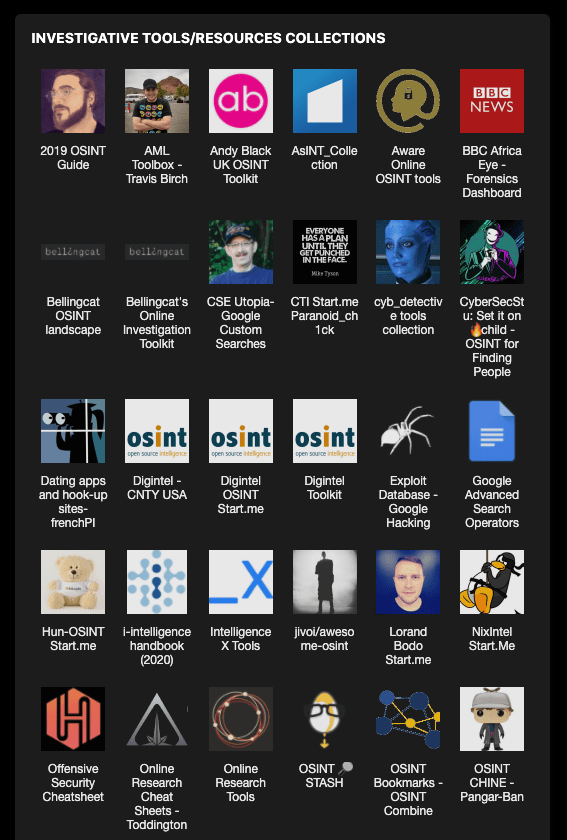
Red or blue, OSINT could effectively assist threat agents and researchers alike in discovering dark places that they may be unaware of. It allows them to create attack scenarios for red teams or hypotheses for threat hunting. Most cybersecurity initiatives, in my opinion, should include OSINT; a service that is often overlooked. A fantastic one-stop shop for the best OSINT content is compiled by @hatless1der and is available at the website: https://start.me/p/DPYPMz/the-ultimate-osint-collection.

Investigative tools/resources collection from Hatless1der OSINT collection.

Please remember to get in touch if you want to learn more about cyber security research and OSINT.

Where are we today with IoT Security Standards?

IoT security standards are necessary because the IoT is fundamentally insecure. It is hard to predict whether or not an IoT device will be hacked, and even if it is, what data will be compromised. There must be defined criteria for security standards for this technology to evolve responsibly without introducing new problems. Here is a quick rundown of some of the most recent security standards.

In the United States, in December 2020, the IoT Cybersecurity Improvement Act of 2020 was signed into law. This is the first piece of IoT legislation in the US aimed at ensuring that federal agencies only buy IoT devices that adhere to strict security protocols. A new cybersecurity standard for consumer IoT (ETSI EN 303 645 V2.1.1) products was introduced in the European Union in June 2020. The purpose of this standard is to encourage better security practices and the use of security-by-design concepts in the creation of new connected consumer products. The Department of Culture, Media, and Sport in the United Kingdom announced new measures also in June 2020 to protect users of internet-connected household devices from cyberattacks. They implemented a product assurance scheme that requires certified IoT devices to bear an assurance label or kitemark indicating that they have completed independent testing or a thorough and accredited self-assessment process.

When it comes to the IoT, one of the most crucial considerations is security. As the IoT grows more intertwined in people’s lives, security standards are required to keep it safe from hostile attacks and prying eyes. There is so much that can be done to improve IoT security, and this is an opportunity for bright minds to get together and influence the IoT’s future.

Finally please remember that you are welcome to contact me and suggest themes for future posts.

The Benefits and Drawbacks of Doing a Ph.D. at Different Times in Your Life 

A Ph.D. is a big commitment, and there is no doubt that it is a big investment in your future career. Figuring out when to make this investment can be tricky, but there are a few factors to consider to find the right time for you.

For most people, their 20s are the perfect time to do a Ph.D. That is when your career is just beginning, you can take advantage of the opportunities that being a student provides, and you still have lots of energy and enthusiasm for the subject after several years of hard work. The problem, though, with youth is that they may not be adequately aware of the commitment a Ph.D. requires. One can argue that they are not mature enough to understand that they will need to work long hours to do well.

For other people, there are many benefits to starting a Ph.D. as late as in their 50s or 60s. You might have already achieved financial stability or professional goals, and carrying on with a Ph.D. may be something you want to do for yourself. On the other hand, it can be harder to do a Ph.D. as an older student because of a lack of time and energy.

Overall, the benefits and drawbacks of doing a Ph.D. at different ages depend on individual circumstances and goals. But your life stage will have a significant impact on your Ph.D experience and your career prospects. I think, overall, the right time to do a Ph.D. is when you have a stable life. If you are a single person, it is also important to make sure that you have enough time to devote to your research and still have the ability to have a social life.

You are welcome to contact me for more information and tips on what it is like to be a Ph.D. student, particularly in Sweden, but also worldwide.

How to Find a Good Research Topic?

Finding a good research topic is not an easy task. Rookies and even seasoned professionals struggle with brainstorming about topics in academic or workplace settings. If you have not already been through the process of selecting a dissertation topic and writing your Ph.D., then it is best to think about suitable research topics before starting work on your dissertation.

There are numerous research topics that you can investigate and write about. Whether you choose to specialize or explore different areas at the same time, you need to ensure that your research topic will help establish your reputation as a professional in the field. The most important thing to remember when choosing a study topic to write about is to choose one that has a lot of promise.

There are various ways to find a good topic. You could find a gap in the scientific literature, you could look into emerging technologies, or you could focus on an issue that has personal meaning for you. No matter how you go about it, it is important to familiarize yourself with a topic before diving right in.

A good research topic is likely to carry you through your entire thesis and/or dissertation process. While the process of finding a topic may be difficult and time-consuming, the rewards are great. When done correctly and with effort, this will be a good exercise for you and will help you in the future. Once you have the right topic, your thesis will come to you naturally.

If you need help deciding on a topic for your thesis or your next paper, please do not hesitate to contact me.

The Importance of Information Ethics in the Digital Age

Over the years, the world has witnessed a technological evolution that has resulted in the World Wide Web becoming a location where information about individuals is acquired and spread. Information ethics is a subset of ethics that investigates the impact of information technology on society. It draws on a variety of fields, including philosophy, law, and computer science. Information ethics seeks to assist us in thinking about how we, as individuals, companies, governments, and societies, think about information: what it is, where it comes from, and how we use it. With the rapid rise of ubiquitous computing and networks, it is becoming an increasingly essential topic of research.

As our world gets more interconnected, individuals must make more responsible decisions about how they acquire, use, and share information with others. Making these decisions can be challenging at times, especially when there is little information available to assist us in deciding what is acceptable and what is not. If one’s actions or inactions have the potential to cause harm to others, one should be held accountable. Information ethics looks at what is right and wrong in relation to information systems. But where can we find these rules, and how can we apply them to the Internet, particularly to the Internet of Things, where certain key decisions are made automatically by machines?

This is a topic that I have been researching for the past few months. I was able also to publish a paper on this topic. If you are a scholar or simply are interested to explore ethics, I recommend reading the book “Ethics & Technology: Controversies, Questions, and Strategies for Ethical Computing” by Herman T. Tavani.

The Right Way to Review a Scholarly Manuscript for a Journal

A manuscript is a document that is submitted to a publisher for publication as a book, article, or other type of written work. A journal article is a piece of writing that is published in a scholarly journal.

To be indexed, the scholarly journal must have been examined by experts in the field as well as independent scholars who are not affiliated with the authors’ institution(s). The criterion for inclusion can differ from one journal to another.

Reviewing a manuscript.

Reviewers are supposed to provide authors with constructive feedback. They should discuss what is good about the manuscript, i.e., its strengths, and how it could be improved, i.e., its weaknesses. As far as possible, reviewers should refrain from passing judgment on how good or awful they believe the work is, instead focusing on what areas of content are well implemented and which could use better. When reviewing a manuscript, I tend to follow the three-step procedure described below.

First, I read the entire manuscript and jot down any remarks that come to mind as a result of the reading. Following that, I generate questions regarding the language, such as what appears to be confusing or unclear, and whether sections of the text may be enhanced or expanded upon. Aspects I focus on include the manuscript’s: structure and content; novelty, originality, and empirical validity; use of suitable methodology; and clarity and precision of communication. Finally, I draft comments in the form of questions and editing suggestions for the authors but also keeping in mind the intended audience of the manuscript.

Peer review is an important aspect of the scholarly process since it ensures that published work meets standards of quality and originality. However, peer review takes time and can be difficult to implement on a large scale.

If you wish to learn more about reviewing scholarly publications, please contact me or leave a comment below. Also, if you are an author and you need a reviewer for your manuscript, you are welcome to get in touch.

My FOSAD experience and Ph.D. security courses

Going back to the summer of 2016, I had the opportunity to attend a summer school on information security. It was the International School on Foundations of Security Analysis and Design (FOSAD) held in the University Residential Center of Bertinoro, Italy. FOSAD is one of the best Ph.D. summer schools I have ever attended.

There were various outstanding and demanding presentations on a wide range of topics, including mathematical models, analysis tools, and Internet security, as well as formal verification of security protocol implementations, practical system security, and others. We also covered information security from a practical perspective as well.

Aside from education, we also enjoyed the Italian countryside, breathtaking views, exquisite food, and some local wine. I had the opportunity to meet and mingle with exceptional students from all around the world, as well as professors from renowned universities. This also helped me in the expansion of my academic network.

If you are a Ph.D. student or simply you want to delve deeper into the intricate world of information security, I recommend attending FOSAD, preferably in person. It is a challenging summer school, but it is one of the best schools I have ever attended.

Here is a group photo from that event.

FOSAD 2016 group photo (adapted from http://www.sti.uniurb.it)

More details about FOSAD can be found on their website: https://sites.google.com/uniurb.it/fosad

Finally, if you want to learn more about security-related Ph.D. courses organized in Sweden, I highly recommend that you visit the website: https://swits.hotell.kau.se/Courses/SWITS-PhD-courses-in-IT-security.htm

Also, please feel free to drop me an email or a tweet in case you want to know more about Ph.D. courses in general.

Life as a postdoc

What is a postdoc? A postdoctoral researcher (postdoc) is a scientist who receives advanced training in a certain domain by collaborating with a subject matter expert. It is a temporary position that bridges the gap between a Ph.D. and a career in academia. There is no other job like this. You get to choose what you want to accomplish and how you want to do it as a postdoc. You may work on new projects almost autonomously or design your research projects with the help of your mentors. 

My work as a postdoc in computer science focuses mainly on cyber security and digital privacy. Most of my days are spent researching topics like machine learning and artificial intelligence, as well as how they may be utilised to automate security processes and privacy management on the Internet of Things. I examine solutions that have been developed to assist secure systems and user data against evolving threats. Some of the domains I am researching are related to smart buildings and smart homes.

Life as a postdoc can be challenging, but it is also full of opportunities. Aside from your research tasks, which will mostly revolve around publishing, you will be required to take on responsibilities that go beyond those of your Ph.D. You could be handling administrative tasks, including funding applications and working long hours in the lab, as well as lecturing and supervising Bachelor’s or Master’s students. Fortunately, I had the opportunity to complete the majority of the aforementioned activities throughout my Ph.D.

What else can I say? On a typical day, there is rarely a moment when I am bored or feel as if I do not have enough to do. You will likely find a large amount of freedom in what you choose to focus on. You do not need to think about whether you are using your time well because there is so much interesting work to be pursued! Of course, I am biased here because my postdoc themes are partly related to what I studied during my doctoral studies and on which I have industrial expertise.

If you want to learn more about postdoc life in Sweden, have questions about my research interests, or simply want to get in touch, you are welcome to email or tweet me.