Talk about my Research Topics at Vetenskapens Dag

Today, I was invited to speak about my research topics at Vetenskapens Dag (Science Day).  Here, I did a short talk to IT and Economics students in Malmö University where I touched on the following topics:

  • What is a smart connected home?
  • Why it is important to study smart homes?
  • What data are being collected by connected devices?
  • What risks to security and privacy are introduced by such IoT devices?
  • Who are the threat agents interested in gaining a foothold in our lives?
  • What can we do as consumers to protect ourselves?

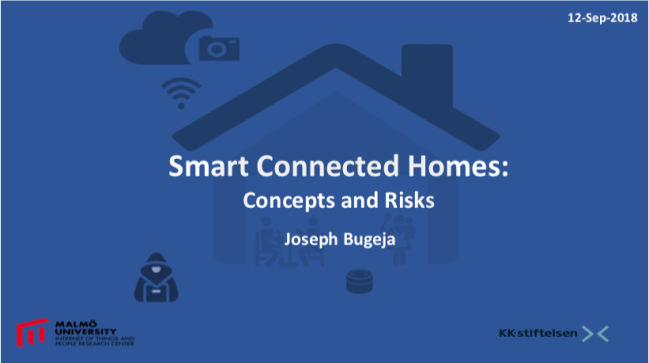
Below is a screenshot of my presentation cover:
Please feel free to get in touch if you want to know more about this and related!


My Licentiate Seminar

On Monday, 03 September, I have my licentiate seminar at Malmö University.  On that day, I will give a presentation, where I will talk for about 40 minutes about the smart connected home ecosystem.

Here, I will emphasize the security and privacy risks such as an Internet of Things system bring to the smart home residents, threat agents interested in conducting attacks on the home,  challenges in implementing effective mitigations, and more.

This talk is essentially a summary highlighting key parts of my licentiate thesis (see picture of it below):

The full thesis is 192 pages long with a word count of about 48,000 words.

Take a look at my thesis and upcoming seminar by following the link: http://iotap.mah.se/smart-connected-homes-joseph-bugeja/


Data Collected by Smart Home Devices

What type of data smart home devices collect? This is exactly what I talked about last week in Seattle (USA) at the Services Conference Federation (SCF 2018). Understanding the data smart home systems collect is useful to assess what is at stake if a device is compromised and as a precursor for conducting privacy analysis.

Image result for data privacy

By analysing the privacy policies of different smart home and IoT device manufacturers we observed that all investigated devices collect instances of personal data. This in the worst case can include biometric data. Such data is used for instance in smart TVs for authentication purposes and sometimes to support advanced interaction features.

However, there are many other instances of non-personal data which when aggregated can truly paint a detailed coarse-grained model of an individual’s lifestyle preferences, habits, and history.

Read more: https://www.springerprofessional.de/an-empirical-analysis-of-smart-connected-home-data/15852434

Efficient Way to Convert Multiple PDFs to Plaintext Format

Researchers often have to analyse data. Sometimes, data are contained in PDF files. While most of the commercial analysis tools, e.g., NVivo, support working with this file format, oftentimes it is better to have these converted to plaintext format, especially if you need to do some preprocessing (e.g. stemming words, removing digits, conflating whitespaces, etc.). While, it is can straightforward to do this from most PDF editors, it becomes cumbersome and time-consuming when you are dealing with multiple files.  On Linux/Mac a quick way of solving this is to use the package (pdftotext) as follows:

for file in *.pdf; do pdftotext -nopgbrk -eol unix "$file"; done

Here, we converted all PDFs found in the current directory to text format.

Alternatively, you can also use pandoc package. This is a very powerful tool that can convert files from multiple sources to different formats, e.g., Markdown, LaTeX, EPUB, and many more.  E.g., hereunder we are converting all text files found in the current directory to PDF format:

for file in *.txt; do pandoc "$file" -o "$file.pdf"; done

Hope you will find this useful!

Creating a Hierarchical Taxonomy Through Latex

One of the things researchers have to occasionally develop is a taxonomy. Essentially, a taxonomy is a process that helps classify concepts in a logical manner.

There are many different tools and methods to help draw a taxonomy. But, if you are working with Latex, you can easily do so through the “forest” package. I am showing here a simple example of how you can draw one to represent household appliances and kitchen aids in a smart home:

Screen Shot 2018-04-04 at 08.02.49

The result of running the above code is the graphic presented hereunder:

Screen Shot 2018-04-04 at 08.04.36

Hope you will find this useful!