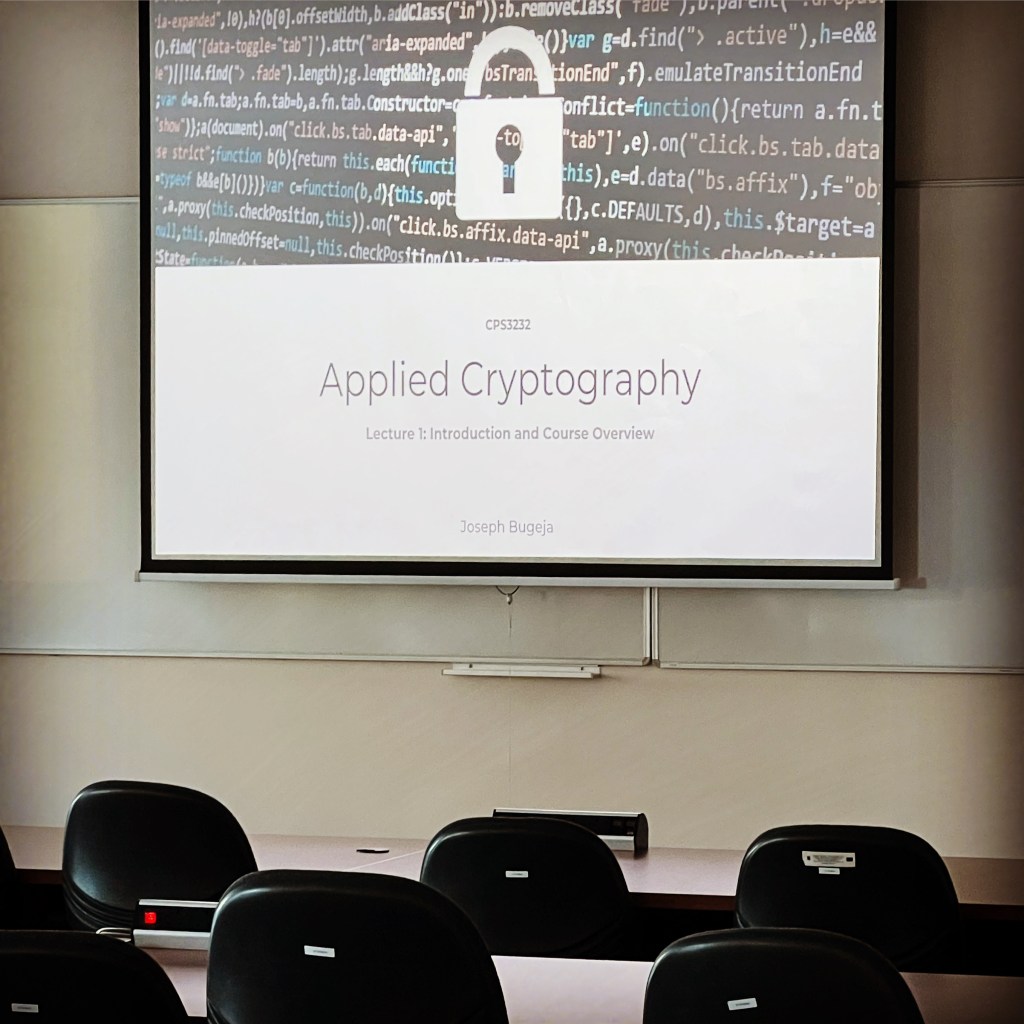
My First Lecture at the University of Malta

Snapshot of the title slide captured prior to the lesson.

I initiated the Applied Cryptography course at the University of Malta on Monday evening. As a cyber security professional and academic with a strong commitment to the field of information security, I am genuinely excited to be leading this specialized academic course this year.

Throughout the introductory lecture, I delved into the foundational concepts of cryptology, emphasizing its profound relevance within contemporary security applications. The pedagogical discourse traversed a diverse spectrum of topics, encompassing cryptographic mechanisms, the examination of classical substitution ciphers and their formal representations, a concise introduction to cryptanalysis, and more.

I am excited to be a part of this journey and look forward to the next lecture in this course on Monday!

Understanding the Benefits of Academic Freedom

Photo by Pixabay on Pexels.com

Academic freedom is a fundamental right that ensures professors and students can conduct research, teach, and discuss ideas without fear of institutional censorship. This right is enshrined in many of the founding documents of higher education, including the American Association of University Professors’ 1940 Statement of Principles on Academic Freedom and Tenure, which affirms that “Academic freedom is essential to these purposes and applies to both teaching and research. Freedom in research is fundamental to the advancement of truth.”

Academic freedom is essential for the advancement of knowledge and the protection of academic integrity. It is also beneficial for universities and colleges, providing them with the ability to recruit the best faculty and students and attract high-level research funding. Additionally, it provides an environment in which creativity and innovation can thrive. In practice, academic freedom enables faculty to pursue research and teaching in any field of their choosing and to express their views in the classroom and the curriculum, irrespective of their popularity or controversy. Similarly, students are allowed to challenge and debate ideas in the classroom without fear of repercussions, promoting critical thinking and the exploration of diverse perspectives.

In conclusion, academic freedom is an integral part of a free and open society, essential for the continued advancement of knowledge and the protection of academic integrity. It should be respected and protected in order to ensure the continued growth of knowledge and the success of academic institutions.

Teacher Training in Blekinge

On Wednesday, August 18th, I attended the Teaching Apprenticeship conference at Blekinge University of Technology. The conference was held in a hybrid format, meaning that we could attend sessions both in person and remotely. The conference was informative, and I came away with a greater understanding of how to further improve my teaching.

The theme for this year’s conference was active academic teaching for pedagogical development. The goal of this theme is to increase awareness of educational quality and learning in higher education among educators, educational developers, librarians, and other people with an interest in the subject.

I really enjoyed the keynote given by Klara Bolander Laksov and Max Scheja, both professors of higher education pedagogy. They discussed the dimensions of academic teachership, the role of pedagogical leadership, and provided examples of what can be done at various levels of academic teachership.  I also enjoyed learning more about blended learning from a theoretical perspective. New methods of learning—and new technology to support them—are necessary for students who will be entering the workforce in just a few short years.

A primary objective of higher education is to provide students with the ability to think independently and critically. The ability to use knowledge and skills with judgment, as well as demonstrate higher-level thinking skills, is essential in many academic disciplines. As teachers of students across Sweden and around the world, we must be willing to change our teaching styles and adapt to new methods and technologies to aid in fostering critical thinking in our students.