There are many definitions of trustworthiness, but in general it can be described as the ability of a system to meet its objectives while adhering to a set of principles or guidelines. In the context of the IoT, the term “trustworthiness” is often used to refer to the ability of IoT devices and systems to accurately and reliably collect and communicate data.
If you would like to learn more about trustworthiness in the IoT, I suggest reading my latest article on Medium. In the article, I discuss the importance of trustworthiness in the age of the IoT. I also describe trustworthiness and explain why it is important for devices in the IoT. Moreover, I discuss some of the factors that contribute to trustworthiness in the IoT, including reliability, security, and transparency. Finally, I offer some tips on how individuals can ensure that their IoT devices and data are trustworthy.
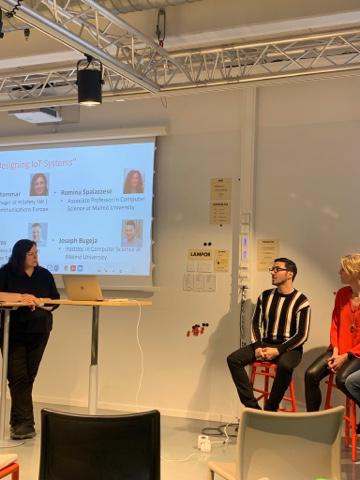
I was invited to participate in a panel discussion at Malmö University on Friday, April 8th. The topic of “Designing IoT Systems” was the one I was asked to speak about. There were representatives from Sony and Sigma Connectivity in the panel with me. Concerns about trustworthiness were a major topic of discussion during the session.
Safety, security, privacy, reliability, and resilience tend to be identified by several researchers as the main trustworthiness concerns in the IoT domain. These concerns are there to ensure that systems function as intended in a variety of situations.
According to several academics, the most challenging aspects of designing trustworthy IoT systems are achieving privacy and security. From applications to devices, each layer of the Internet of Things has its own set of security risks and potential attacks. From a research perspective, a hot topic is that of building energy-efficient security, along with scalable and dynamic security architectures. Preserving data privacy in the IoT, on the other hand, is also particularly challenging. Existing IoT privacy mechanisms are often built for single services, and not necessarily for interdependent, dynamic, and heterogeneous services. Building new privacy preservation techniques for interdependent services is a hot topic, as is federated learning when it comes to data privacy.
Panel discussion on the topic of “Designing IoT Systems”
Finally, there are a number of standards that pertain to trustworthiness. ISO/IEC 30147 “Integration of trustworthiness in IoT lifecycle processes” and ISO/IEC 30149 “IoT trustworthiness principles” are two ISO/IEC standards.
If you want to collaborate with me or learn more about a specific topic that is related to my research topics, please send me an email.
We are guest editing a Special Issue on Privacy and Trust in IoT-Based Smart Homes and Buildings, and would like to personally invite you to contribute a paper.
For this Special Issue we are looking for high-quality original contributions including, but not limited to, the topical areas listed below:
Novel architectures, concepts, and models for trustworthy smart homes and smart buildings;
Privacy-enhancing and transparency-enhancing technologies for smart homes and smart buildings;
Privacy-by-design mechanisms for smart homes and buildings;
Vulnerability discovery and analysis for smart homes and buildings;
Threat modeling and risk assessment for smart homes and buildings;
Attack and attacker simulation for smart homes and buildings;
Trust and identity management for smart homes and buildings;
Access control models for smart homes and buildings;
Human factors in privacy and security of smart homes and buildings.

 Joseph Bugeja