How To Achieve Flow When Writing A Research Paper

When working on your Ph.D., it is imperative to maintain a state of flow. Maintaining a state of flow will give you more motivation towards achieving your goals and finishing work in a timely manner. In addition, maintaining a state of flow will help keep you from getting distracted by less important tasks that are not related to your work, such as checking Instagram, TikTok, Twitter, and other social media platforms.

As Mihaly Csikszentmihalyi asserts in his book “Flow: The Psychology of Optimal Experience”, flow is “the state in which people are so involved in an activity that nothing else seems to matter; the experience itself is so enjoyable that people will do it even at great cost, for the sheer sake of doing it”. Flow is a state in which you are so focused on your work that all other distractions fade away. It is a state in which you are completely immersed in what you are doing, and it is very difficult to pull you out of it. Many Ph.D. students struggle with maintaining a state of flow in their research work. They want to work hard and do well, but they just cannot seem to find the motivation or energy needed to complete their projects. Here are four tips that might help you achieve flow:

Photo by Scott Graham on Unsplash

1)  If you want to be able to write effectively, then you need to set aside time each day for writing. This can be done by creating a schedule and sticking to it. The schedule needs to include the amount of time that you will be spending on your writing tasks each day, as well as any breaks that you plan on taking during the day.

2) Before sitting down, make sure you have everything ready — your notes/laptop/pencils/paper/etc. — so that when it comes time to work on something important, there are no delays caused by having to look for something else first, rather than just getting started right away without any more delays than necessary.

3) Disable any notifications from social media platforms including televisions and phones so that they do not distract you while working on your project. You can always check these platforms or media after completing your tasks for the day, but if they are distracting, then they should be turned off for better focus during working hours.

4) Take frequent breaks, but keep them short and to the point. Consider also using the Pomodoro Technique. The Pomodoro Technique is a time management technique where you work using 25-minute work sprints and then enjoy a 5-minute break.

It is just as important to maintain a state of flow as it is to establish one at the start of your work. The two things go hand in hand. However, maintaining flow can be more difficult at times because some things that interrupt flow are not always avoidable. In order to stay on top of your Ph.D. while maintaining a state of flow, you need to be organized and efficient. By setting aside enough time each day for writing and making sure that you have everything ready before sitting down to work, you will be able to focus more fully on the task at hand, which should contribute towards maintaining a state of flow.

Do You Need to Wait for Perfect Results Before Publishing?

You are lucky if you are already thinking about writing your first scientific publication based on your Ph.D. work. Writing a publication is one of the most important skills that any researcher must acquire during their Ph.D. period. However, students often ask the question, of whether they should wait for “perfect” results before publishing their first paper.

My advice is to write when your work is mature enough that you can cut it into bite-sized pieces that interest others, and then go ahead and start writing. At the end of the day, writing is a cyclical process, and you can only get better at it by writing. Apart from the personal satisfaction of completing an article and seeing it accepted in a peer-reviewed journal/conference, it gets you excited about the project (it gives you motivation). It also makes it much easier for you to progressively make progress by writing in steps and establishing milestones. In doing so, when you get to the final rewriting stage, it will not feel like a mountain to climb. It should be something that builds naturally upon what has already been done.

So, I personally think that the quicker you start to publish, the quicker you will build up a track record of publications. You can use this track record to get funding or a job at the end of your Ph.D., which is key for your career.

How to Find a Good Research Topic?

Finding a good research topic is not an easy task. Rookies and even seasoned professionals struggle with brainstorming about topics in academic or workplace settings. If you have not already been through the process of selecting a dissertation topic and writing your Ph.D., then it is best to think about suitable research topics before starting work on your dissertation.

There are numerous research topics that you can investigate and write about. Whether you choose to specialize or explore different areas at the same time, you need to ensure that your research topic will help establish your reputation as a professional in the field. The most important thing to remember when choosing a study topic to write about is to choose one that has a lot of promise.

There are various ways to find a good topic. You could find a gap in the scientific literature, you could look into emerging technologies, or you could focus on an issue that has personal meaning for you. No matter how you go about it, it is important to familiarize yourself with a topic before diving right in.

A good research topic is likely to carry you through your entire thesis and/or dissertation process. While the process of finding a topic may be difficult and time-consuming, the rewards are great. When done correctly and with effort, this will be a good exercise for you and will help you in the future. Once you have the right topic, your thesis will come to you naturally.

If you need help deciding on a topic for your thesis or your next paper, please do not hesitate to contact me.

Using Mindmaps to Organize My Writing

Especially, when working with a long manuscript but as well when you want to organize concepts and brainstorm ideas, mind maps offer a great visual tool for helping in that.

You can draw mind maps by hand but personally, I prefer to use software tools for this. A tool that I find particularly effective is XMind. I have used the free version of this software to layout the structure of my thesis. Once you know the shortcuts keys you can layout a structure in minutes and then refine it accordingly.

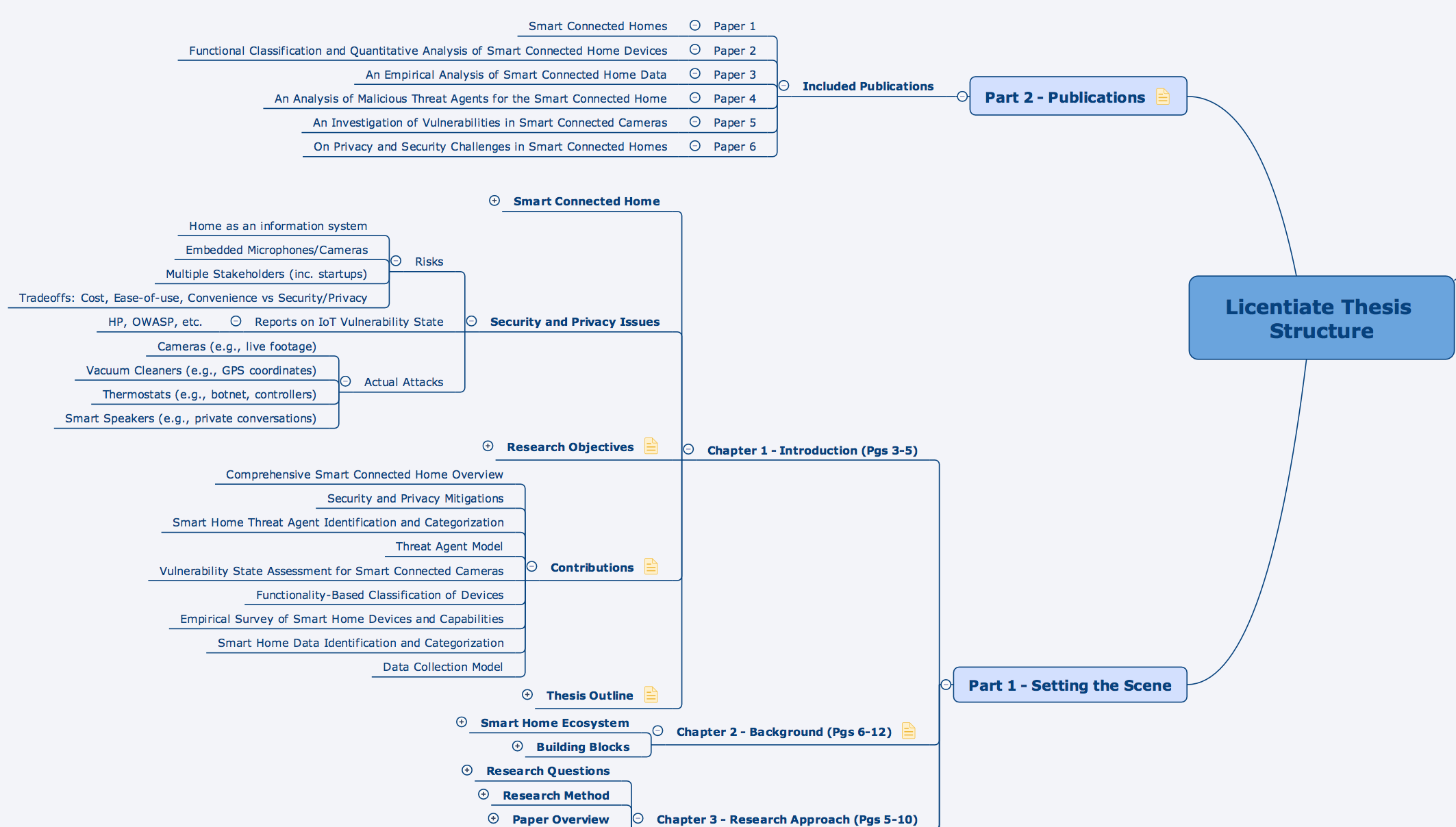
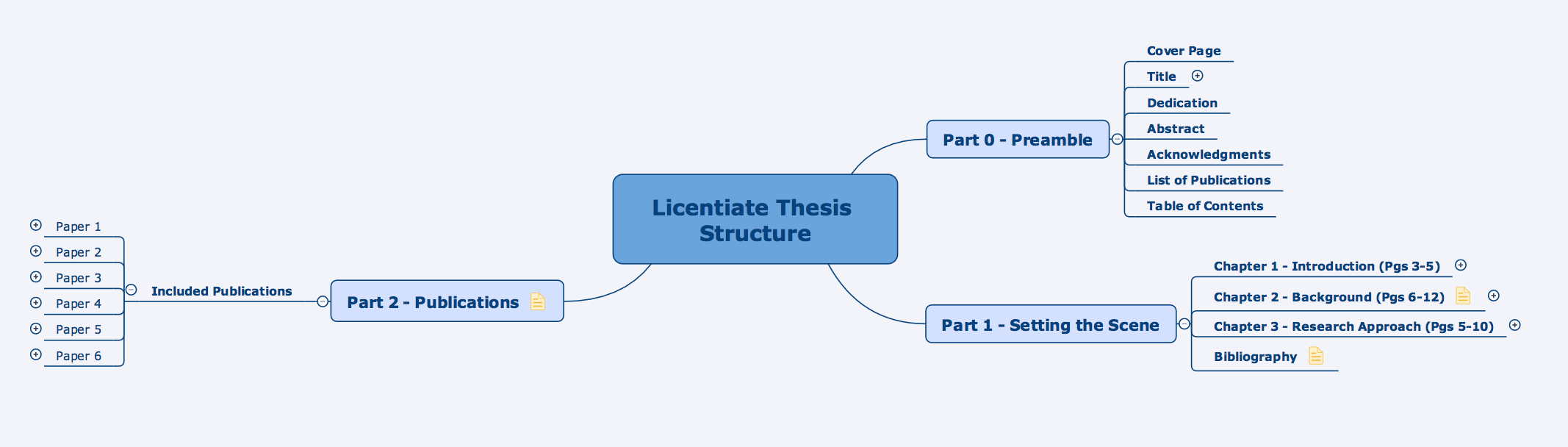
Take a look at the main structure of my licentiate hereunder and an expansion of it in the second diagram.

Screen Shot 2020-04-10 at 16.06.00

Mind map showing the main structure of my licentiate thesis.

Screen Shot 2020-04-10 at 16.08.45

Expanding the nodes of the mind map to show some of the concepts I have used for Part 1 and Part 2 of my thesis.

At the moment, I am also working on an idea for my journal article, and have already created a structure for that as a mind map. After I get the structure ready and approved by my coauthors, I can start working on the actual text. I would already know how the pieces would connect together in a cohesive structure and flow well if I follow the mind map in my writing.

Certainly, if you need help on how to create mind maps for your manuscript, course, talk, or for whatever reason you may have, feel free to get in touch.