Open-Source Smart Home Simulators

Following, a blog post I have written in 2019 focusing on real smart home testbeds, a lot of readers have reached out asking me if I am aware of tools that can be used to simulate smart home data. I understand this request, because data collection in smart homes can be a tedious, time-consuming, and expensive process.  I identify three of the recent open-source tools that could be useful to simulate activity and human interactions within a smart home, below:

  • OpenSHS (Open Smart Home Simulator) [1]: This is a hybrid, open-source, cross-platform 3D smart home simulator, developed using Blender and Python, allowing for sophisticated dataset generation.
  • Francillette et al. simulator [2]: The authors developed a smart environment simulator, using Java, SketchUp, and Unity engine, capable of generating data from simulated sensors such as RFID, ultrasound, pressure sensors, and contact sensors, amongst others.
  • Smart Environment Simulation (SESim) [3]: This is a simulation tool developed in Unity that supports smart home simulation and the generation of synthetic sensor datasets.

Also, in case you are a researcher and you would like a copy of the data I collected about the technical specifications of smart home products, feel free to get in touch.

[1] Alshammari, N.; Alshammari, T.; Sedky, M.; Champion, J.; Bauer, C. OpenSHS: Open Smart Home Simulator. Sensors 201717, 1003. https://doi.org/10.3390/s17051003

[2]  Francillette, Y.; Boucher, E.; Bouzouane, A.; Gaboury, S. The Virtual Environment for Rapid Prototyping of the Intelligent Environment. Sensors 201717, 2562. https://doi.org/10.3390/s17112562

[3] Brandon Ho, Dieter Vogts, and Janet Wesson. 2019. A Smart Home Simulation Tool to Support the Recognition of Activities of Daily Living. In: Proceedings of the South African Institute of Computer Scientists and Information Technologists 2019. ACM, Article 23, 1–10. DOI:https://doi.org/10.1145/3351108.3351132

Hosting Virtual Classes using Zoom and Discord

On Monday, 18 January, I delivered my first lecture for 2021 in my cybersecurity course at Malmö University. This year, is my 5th year running this course, and I have about 120 students registered for the course. This is a good turnout, and I am happy that many students are keen to learn about cybersecurity. Unlike previous years, the full course, including all its deliverables are going to be held online.  So, anyone provided with the link to the lecture and an Internet connection can access the lecture live, potentially from anywhere without the need to commute to university.

When it comes to lectures, I am using Zoom as the main software program to share my slides and interact with students. One of the cool features of Zoom, which is similar to that of a traditional classroom, is its whiteboard. Effectively, Zoom allows the host to share a digital whiteboard that can be used in a similar way to a physical whiteboard but supporting more options. When using Zoom’s whiteboard, I commonly connect my tablet to the meeting and start sketching out using a digital pen. It can be quite challenging to draw a diagram using only a computer mouse. 

Sharing the Whiteboard on Zoom

Sharing the whiteboard on Zoom.

Another nice feature of Zoom, that I started using recently, particularly for managing a workshop, is called “breakout rooms.” This function allows the meeting host to split the participants into smaller groups so that participants can discuss separately in different rooms without disturbing others. I have seen the use of “breakout rooms” in many virtual conferences I have participated in recently. The partitioning into groups can be done automatically or manually, or otherwise, the host can allow participants to select and enter breakout sessions as they please. 

As a complement to “breakout rooms” in Zoom, I am also using Discord for supporting students, especially in their lab practicals. Discord is a VoIP, instant messaging, and digital distribution platform, particularly popular with gamers. In our case, we found Discord to be fast and reliable for handling voice and video simultaneously. Its straightforward participation system also makes it ideal for assisting students in their practicals. 

In case you want to learn more about my experience with digital teaching, please feel free to get in touch or leave a comment below.

Lecturing about security and blockchain in a Masters course

On 24 November, I was invited to deliver a guest lecture to Masters students in Computer Science at Malmö University.  The lecture’s main topic was IoT security and the application of blockchain as a security-enhancing technology.  It was fun doing this 2-hour lecture over Zoom, and especially I was pleased to see some former students attending my lecture.

When introducing blockchain, I focused on a  use-case where this technology is used for securing drone communication. In particular, I referenced the paper titled “Towards data assurance and resilience in IoT using blockchain” which uses some of the properties of blockchain for providing instant and permanent data integrity, trusted accountability, and a resilient backend for drones.  Blockchain has several uses including also in smart homes (e.g., as discussed in the paper titled “Blockchain for IoT Security and Privacy: The Case Study of a Smart Home”) and in many other domains.

Recently, I also co-authored a paper with some of my colleagues where we explored the use of blockchain for countering adversarial attacks in incremental learning.

Inside the dolls house…

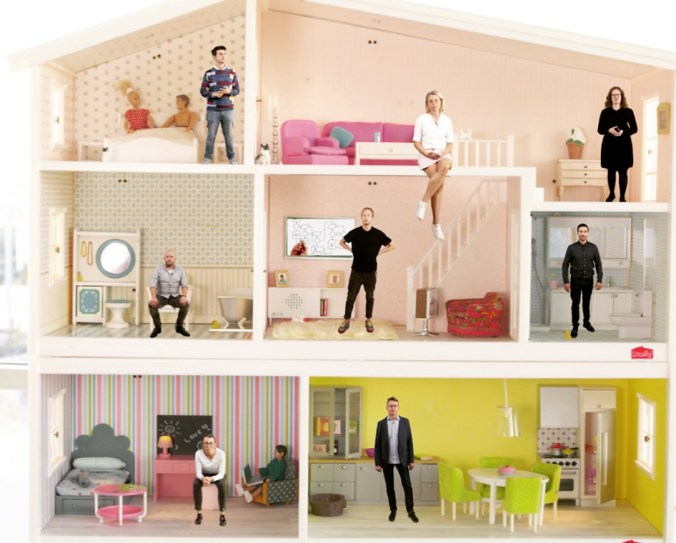
Earlier in September, I participated in a short film showcasing some of the research projects being carried out by the Faculty of Technology and Society, part of Malmö University. The film was directed by Hanna Solberger (media producer at Malmö University) and her talented production team.

This was my first experience of being filmed in a professional studio and being directed by a film crew in Sweden. It was a very professional job filled with amazing touches of creativity by the film director! You can see me featured in the video cover picture below,  inside the most private room in the house…and yes I am talking about privacy 😉

Image taken from the video ‘Människan & Tekniken’.

The video was used for research funding purposes part of the event called ‘Människan & Tekniken’. You can access the full video  by clicking the link here: https://play.mau.se/media/t/0_7vlkv9tz

Memories of a Good Seminar

It has been a bit more than 2 years ago I defended my Licentiate thesis. Here is a wonderful memory from that time! A lot of things have changed since then in the smart home world and also in the course of my research and academic career.


In case you have queries just feel free to get in touch! I am also very much involved in supervising theses on cutting edge technologies of the like of autonomous drones, smart cities, to more industry-oriented work such as measuring the effects of GDPR on IoT consumers.

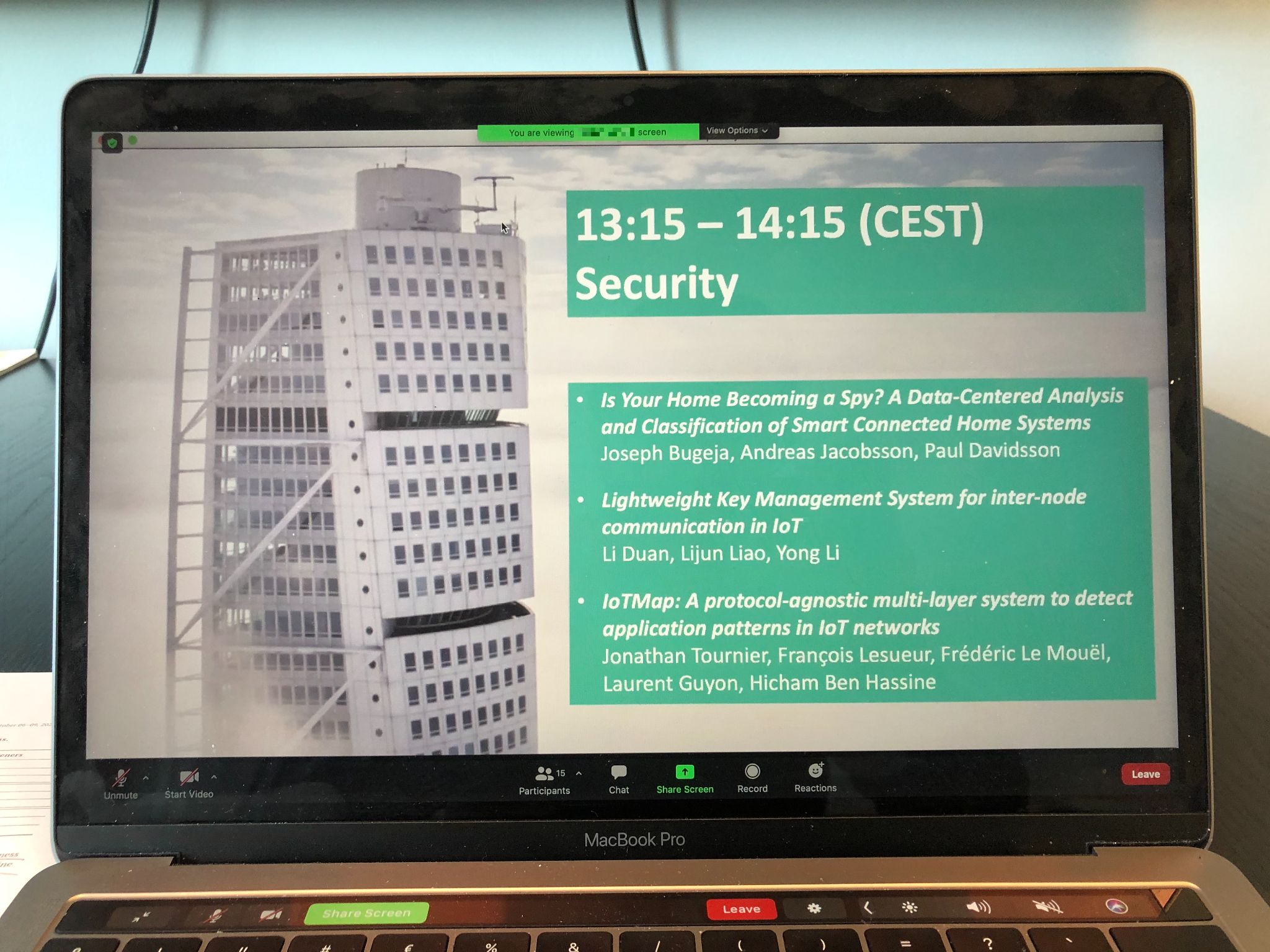
Is Your Home Becoming A Spy?

On 9th October, I had the opportunity to present my paper at the IoT 2020 conference. I talked about smart connected homes to conference attendees participating in the security track. The presentation was pre-recorded and played to an online audience over Zoom.  It was in the format of a 12 mins presentation followed by 8 mins QA.

My presentation slot at IoT 2020.

The theme that I covered was about covert surveillance facilitated through commercial smart home systems retrofitted in homes around the globe.  In the study, we organized 81 systems by their data-collection capabilities with the intention of better understanding their privacy implications. Also, we identified research directions and suggested ways that allow users more control, transparency, and ethical uses over their personal data.

You can take a look at the presentation slides here. Also, please free to email me in case you need more information about my work.

Online Lecture about IoT Security

On 01 October, I was invited to deliver an online lecture about the topic of securing the Internet of Things (IoT) to Lund University Bachelors students. I have been researching security and privacy on a full-time time basis for the past five years and working on information security for well over a decade.

My lecture consisted of a two-hour presentation, where I focused on some key attacks targeting consumer and industrial IoT applications. Denial-of-service attacks, routing attacks, and service attacks of which we have been talking about for many years have become even more serious. For instance, think about Mirai, the botnet which broke out in 2016, and other malware targeting unsecured IoT devices such as webcams. This is partly happening due to the interconnectedness of the devices, but especially due to a lack of inbuilt security measures. In this regard, Vint Cerf, one of the computer scientists hailed as a founding father of the Internet, said in an ACM panel in 2017:

“The biggest worry I have is that people building [IoT] devices will grab a piece of open source software or operating system and just jam it into the device and send it out into the wild without giving adequate thought and effort to securing the system and providing convenient user access to those devices.”

Although plugging any device to the Internet is becoming the trend especially with the rise of the IoT, I believe that companies should put in more effort into securing their devices prior to releasing them to the consumer market. Unfortunately, it is still common to run simple attacks, such as SQL injections, on IoT devices, and finding them vulnerable to that.

My Final Seminar

On September 18, I had the opportunity to present my PhD work to my fellow colleagues at Malmö University.  I had a 25 minutes slot, over Zoom, where essentially I summarized my research topic and presented my main contributions to the scholarly and industry community.

The discussion was led by Assoc. Prof. Martin Boldt from Blekinge Institute of Technology.  We had a very detailed and insightful 90 minutes conversation about smart homes, IoT, security and privacy.  After the meeting, I also received detailed written feedback about my work.

Some interesting points raised during our exchange are how homes are evolving and becoming more interconnected to different networks and services (whether it is the entertainment providers, healthcare providers, smart grids, and more).  With this evolution, the role and function of our home but as well our expectations of privacy are changing.  What if our intimate data gets in the hands of criminals? What if companies providing our services get hacked? What if our home technology is covertly spying on our children? These are some of the topics we talked about.

You can take a look at a redacted version of my presentation here.  A full version of the presentation will be uploaded in due time.

That is a Wrap On Computing 2020

As a follow-up to my previous blog post, I can say that it was an honor to participate yesterday and on Thursday at the Computing Conference 2020.  It was very well organized, professionally executed, and fun!

There was a wide range of presenters coming from different research areas covering computing, AI, security, IoT, and much more. It was also cool to have a Mindfulness and Yoga general session at the conference. This was something unique!

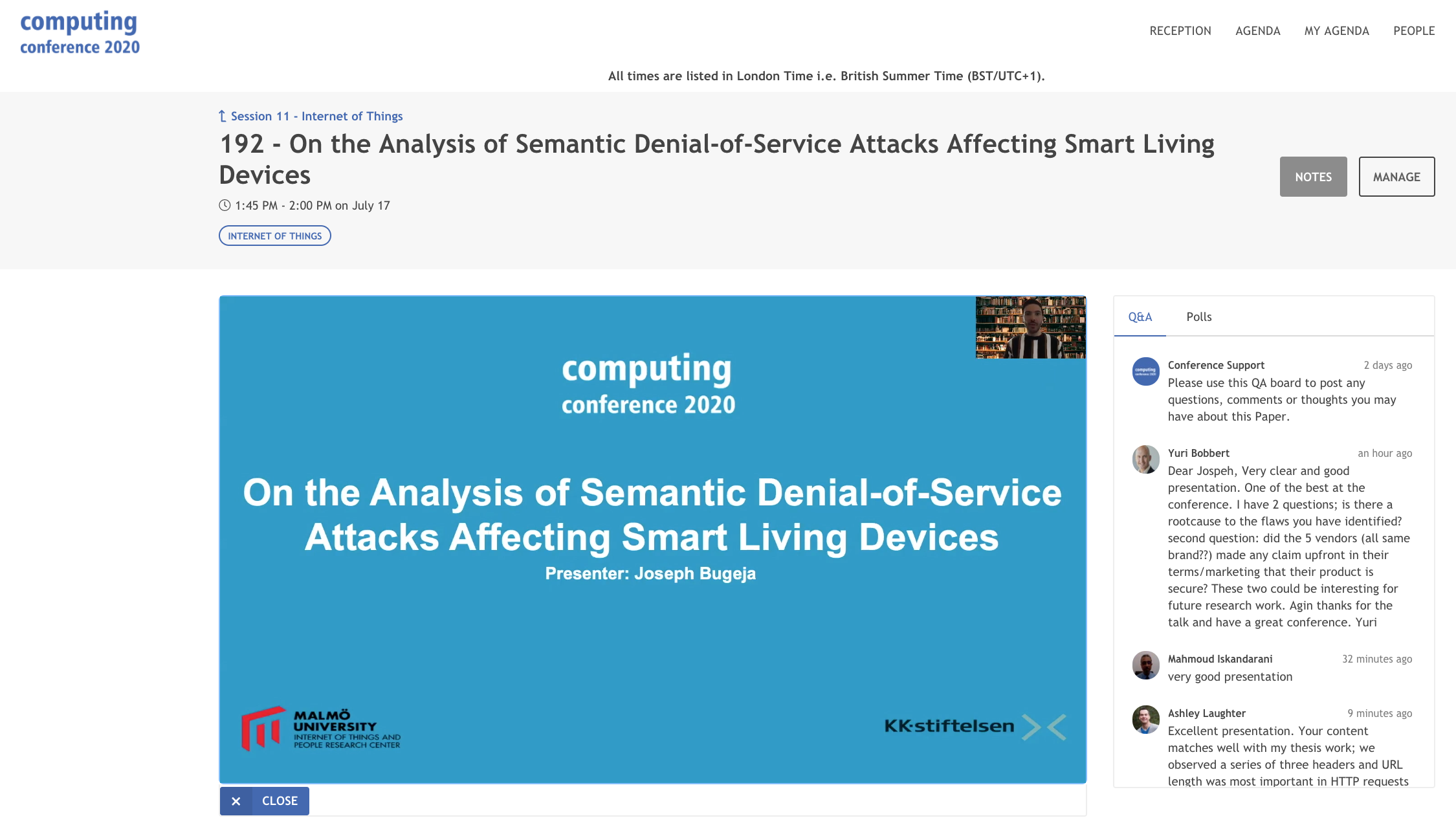
Here, is a screenshot of my presentation with feedback received. Also, I got private messages for collaboration work and I truly appreciate those!

My Presentation

My presentation with feedback received.

Once again thanks for the thumbs up and already looking forward to next year’s edition!

Talking about DoS Attacks at the Computing Conference

On Friday, 17 July 2020, I will be talking at the Computing Conference 2020. This conference going was going to be held in London but due to the COVID-19 pandemic, it is now going to be held fully online. I am especially excited to listen to the keynote of Vinton G. Cerf. He is widely known as a “father of the Internet”. Cerf is also the vice president and Chief Internet Evangelist for Google.  During the conference, I will be talking about Denial of Service (DoS) attacks and how commercial devices are prone to severe forms of this attack.

DoS is a widely used attack vector by various malicious threat agents from hackers to nation-states. Its consequences range from a nuisance to loss of revenues to even loss of life. Think about for instance the effects of disabling medical devices such as pacemakers, drones and weapon systems, connected alarm systems, and so on. In the case of smart homes, DoS may be the first attack to remove a component from a network to exploit a vulnerability.  In our study, we found devices manufactured by established commercial players prone especially to HTTP GET DoS attacks. This can result in the complete shutdown of the device, possibly remotely, by using a simple exploit with code available over the Internet.

DoS attacks targeting the smart connected home.

Take a look at the conference agenda and have a read of my conference paper. I will be uploading my presentation slides after the conference is held under my Presentations tab.

Feel free to drop me a message or get in touch if you want to know more about this topic or in case you are interested in information security.